


How I Design and Carve an Abstract Sculpture
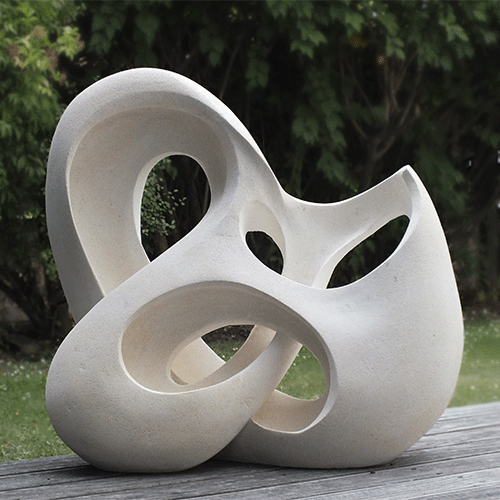
Abstract sculpture is one of those things that's hard to explain before you've done it — and almost impossible to stop doing once you have. The freedom of it is unlike anything else in carving. You're not trying to replicate something that already exists. You're trying to find something that no one has seen before, and you're finding it inside a block of stone.
Here's how my process works.
It Starts With a Lot of Sketches
I start with A3 paper and a pencil, and I just let it go. Wild lines, crazy curves, shapes that don't make sense yet — I'm not trying to draw something specific, I'm trying to generate ideas. The goal at this stage is to let the pencil flow and see what comes out. Music helps. I almost always have something playing.
It can look like nothing for a while. Just a mess of marks on paper. But slowly something starts to emerge — a line that feels right, a shape that has tension in it, a form that suggests movement. When that happens I start working with it, tightening the design, pulling it into something with real intent.
I approach it one of two ways. Sometimes I've already got a block of stone I want to work with, and I design something that fits within its dimensions. Other times I generate the design first and then track down a block that's roughly the right size — or order one directly from the quarry if I need to.
Working Out Both Sides
One of the most important steps — and one people don't always think about — is working out how both sides of the sculpture relate to each other. A sculpture isn't a drawing. It exists in three dimensions, and the composition needs to flow right around the whole piece, not just across the front face.
What I do is hold the A3 sketch up against a window so the light comes through it, and I draw the back of the sculpture onto the reverse side of the paper. That gives me a blueprint for the rear — how the shapes on the back need to mirror, complement or counterbalance what's happening on the front. Once that's sorted, I've got a proper three-dimensional plan to work from.
Getting the Design Onto the Stone
Once I'm happy with the design and I've got the right block, I transfer it to the stone. Sometimes I just sketch it on freehand — a loose copy of the drawing that gives me something to work towards. Other times, when I want to be more precise, I use a grid system to scale the design up accurately onto the stone surface.
Then the carving begins.
Making Decisions on the Go
Here's something I've learned: the design on paper is a starting point, not a contract. Once I'm actually in the stone — feeling how it responds, seeing how the light falls across the emerging form — I'm still making decisions. Sometimes I'll abandon a section of the original design because a better idea has come up. Sometimes the stone itself suggests a direction I hadn't considered.
My aim is always to push for something interesting — crazy angles, twists and turns, things happening in the piece that make you look twice. I want to get into the stone and find forms that create real tension and movement. That's what makes an abstract piece genuinely compelling rather than just decorative.
There's a real ebb and flow to it. You remove material, step back, look, decide what happens next. As the form reveals itself you can make better choices. The sculpture almost starts to direct you.
Why I Love It
Abstract sculpture is very personal work. More so than anything else I make. There's no brief to satisfy, no reference to compare it against — it's entirely an expression of what's in your head at that moment, filtered through the process of working with your hands. I find it therapeutic in a way that's hard to describe. I'm usually outside, sun on my back, music playing, completely absorbed.
And when a piece comes together — when you step back and it has that quality of something you've never quite seen before — it's one of the best feelings in carving.
If You Want to Try It
Don't overthink it. Get a big piece of paper and let the pencil go without trying to draw anything specific. Look for the lines that feel interesting and start working with those. You don't need to know where it's going to end up — that's the whole point.
You might get lost halfway through. You might carve something that doesn't match your original idea at all. That's fine. That's actually how it's supposed to work. The more you do it the more comfortable you get with the uncertainty, and the better the work gets.
Be brave. Good luck.
Interested in learning to carve? Night classes run each term at Papanui High School → or book a workshop →